Tissue Box Project
This year, we used this project at the start of the course. It could also be used later on in the year when we get to Volume and Surface area. Our goal was to use it as a bit of a pre-test to see what students already know about Geometry. It asks students to purchase a tissue box that is in the shape of a rectangular prism. Then, the students cover their box in paper so that they can write over the box. The tasks we ask them to do are area, surface area, volume, and drawing a net. Some class time is given so that students can work together to discuss how to do some of these problems. After the students turn in the project, the tissue boxes are graded and kept in the classroom so we have tissues for the year.
CCSS Connection:
CCSS.MATH.CONTENT.6.G.A.4 Represent three-dimensional figures using nets made up of rectangles and triangles, and use the nets to find the surface area of these figures. Apply these techniques in the context of solving real-world and mathematical problems.
CCSS.MATH.CONTENT.HSG.MG.A.1 Use geometric shapes, their measures, and their properties to describe objects.
Polygons Around the World
Students go on an in class field trip around the world viewing numerous locations where polygons can be found. Throughout this “trip,” students identify and name different polygons in real world structures, list attributes of each polygon including angle types and congruent/parallel sides, calculate the sum of interior angles, identify polygons as regular/irregular, etc. Students complete their Travel Journal as they explore each polygon we find. As an extension, students are asked to find an example not shown during the in class trip and share it with the class the following day.
CCSS Connection:
CCSS.MATH.CONTENT.HSG.SRT.B.5 Use congruence and similarity criteria for triangles to solve problems and to prove relationships in geometric figures.
CCSS.MATH.CONTENT.HSG.CO.C.11 Prove theorems about parallelograms. Theorems include: opposite sides are congruent, opposite angles are congruent, the diagonals of a parallelogram bisect each other, and conversely, rectangles are parallelograms with congruent diagonals.
Tools of Geometry Scavenger Hunt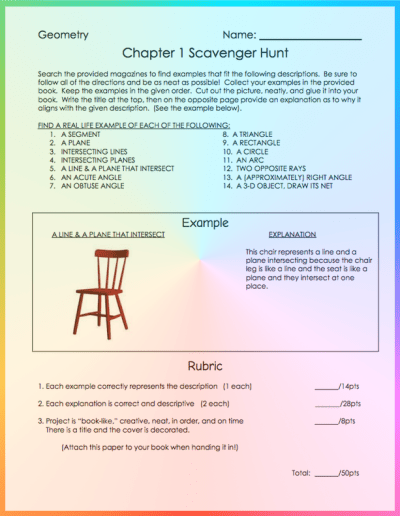
At the end of the first unit in Geometry, students take pictures or find pictures of items that represent things listed on the scavenger hunt list. After they find everything, they put it together in a booklet to turn in. They must write a sentence describing how it aligns to the geometric tool.
CCSS Connection:
CCSS.MATH.CONTENT.HSG.CO.A.1 Know precise definitions of angle, circle, perpendicular line, parallel line, and line segment, based on the undefined notions of point, line, distance along a line, and distance around a circular arc.
CCSS.MATH.CONTENT.HSG.CO.D.12 Make formal geometric constructions with a variety of tools and methods (compass and straightedge, string, reflective devices, paper folding, dynamic geometric software, etc.).
CCSS.MATH.CONTENT.HSG.GPE.B.4 Use coordinates to prove simple geometric theorems algebraically.
CCSS.MATH.CONTENT.HSG.GPE.B.7 Use coordinates to compute perimeters of polygons and areas of triangles and rectangles, e.g., using the distance formula.
Individual and Team Problem Solving – Surface Area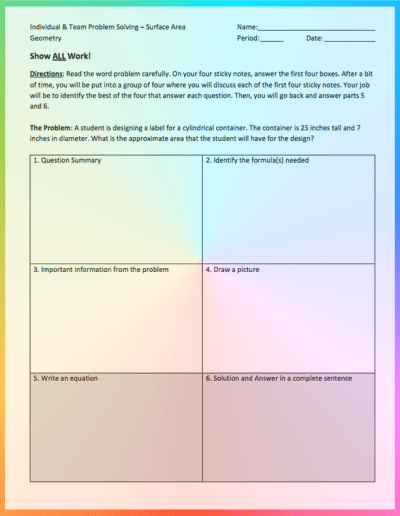
This concept can be used at any level of mathematics. It is especially handy at the lower levels to get those students used to solving word problems. Each student works individually at first, setting up each word problem. Then, they work together with three other students to make sure everyone has the same idea. They copy down on their sheet what the group says is a census, and then solve the problem on their own. The word problem here deals with surface area. The last step gets students to write their solution in a complete sentence citing evidence that it is indeed the solution. The evidence lies within the work they already completed.
CCSS Connection:
CCSS.MATH.CONTENT.6.G.A.4 Represent three-dimensional figures using nets made up of rectangles and triangles, and use the nets to find the surface area of these figures. Apply these techniques in the context of solving real-world and mathematical problems.
 Zach Tocchi's Online Portfolio