Solving Equations Anticipation/Reaction Guide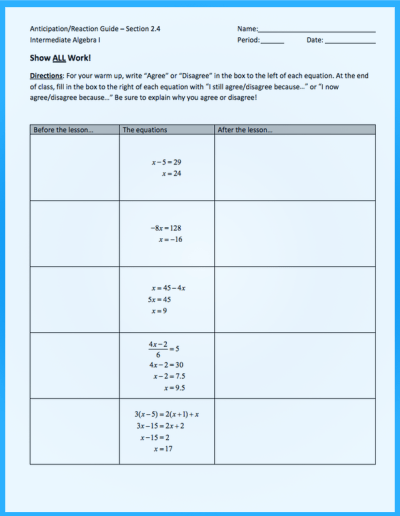
Students received this as an entrance/exit ticket on the second day of lessons surrounding solving equations in one variable. They look at the center column which has an equation solved out. Then they determine whether they agree or disagree with the way the equation is solved. At the end of the lesson, they re-visit the guide and write sentences starting in either “I still agree because…”, “I still disagree because…”, or “I changed my mind because…”. This gets them to explain their reasoning using math terms. Common Core and PARCC are all about explaining and this is one way I like to get students to write in my class. They turn this slip in before leaving the classroom.
CCSS Connection:
CCSS.MATH.CONTENT.HSA.REI.A.1 Explain each step in solving a simple equation as following from the equality of numbers asserted at the previous step, starting from the assumption that the original equation has a solution. Construct a viable argument to justify a solution method.
CCSS.MATH.CONTENT.HSA.REI.B.3 Solve linear equations and inequalities in one variable, including equations with coefficients represented by letters.
Graphing Study Clown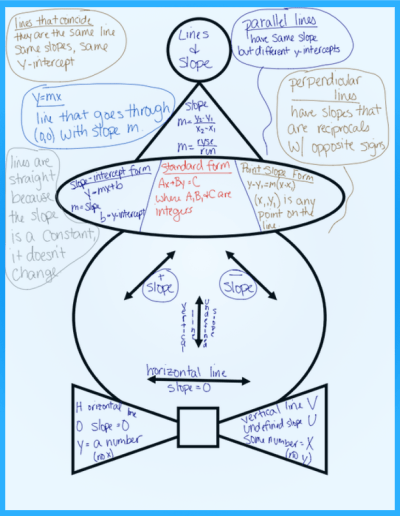
Students receive a blank version of this clown towards the end of the unit on graphing linear equations. We write notes all over the clown that help us remember all the things there is to remember about graphing. A finished clown is also attached. After students copy down everything, they go home with a blank piece of paper and are asked to re-create the clown using their imagination. Some students drew a house, robot, sunflower, etc. By re-writing everything on the clown, it helps students remember what they learned.
CCSS Connection:
CCSS.MATH.CONTENT.HSF.IF.C.7.A Graph linear and quadratic functions and show intercepts, maxima, and minima.
CCSS.MATH.CONTENT.HSF.LE.A.2 Construct linear … functions, … given a graph, a description of a relationship, or two input-output pairs (include reading these from a table).
Tower Activity – Introducing Slope-Intercept Form 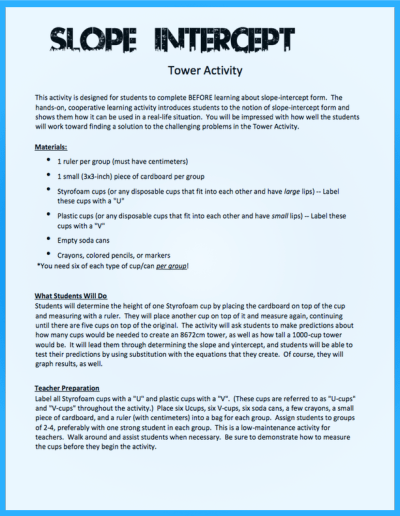
Students learn slope-intercept form through this hands-on, cooperative learning activity. It also shows students how this concept can be used in the real world.
CCSS Connection:
CCSS.MATH.CONTENT.HSF.IF.C.7.A Graph linear and quadratic functions and show intercepts, maxima, and minima.
Solving Systems of Equations Individual Learning Project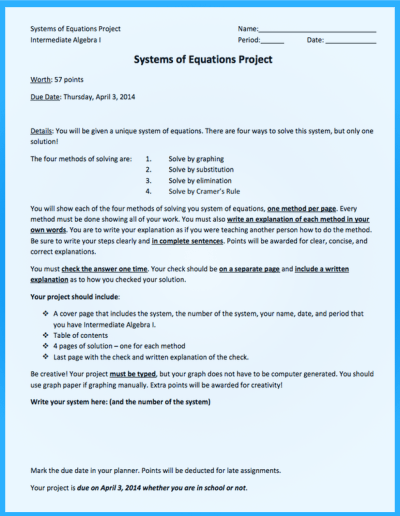
Each student in the class receives a unique system of equations in two variables. They are to solve their system using the graphing method, elimination method, substitution method, and Cramer’s Rule. At the end of the project, the student checks their solution with the original equation.
CCSS Connection:
CCSS.MATH.CONTENT.HSA.REI.C.6 Solve systems of linear equations exactly and approximately (e.g., with graphs), focusing on pairs of linear equations in two variables.
CCSS.MATH.CONTENT.HSA.REI.D.11 Explain why the x-coordinates of the points where the graphs of the equations y = f(x) and y = g(x) intersect are the solutions of the equation f(x) = g(x); find the solutions approximately, e.g., using technology to graph the functions, make tables of values, or find successive approximations. Include cases where f(x) and/or g(x) are linear, polynomial, rational, absolute value, exponential, and logarithmic functions.
CCSS.MATH.CONTENT.HSA.REI.C.5 Prove that, given a system of two equations in two variables, replacing one equation by the sum of that equation and a multiple of the other produces a system with the same solutions.
 Zach Tocchi's Online Portfolio